The Drift
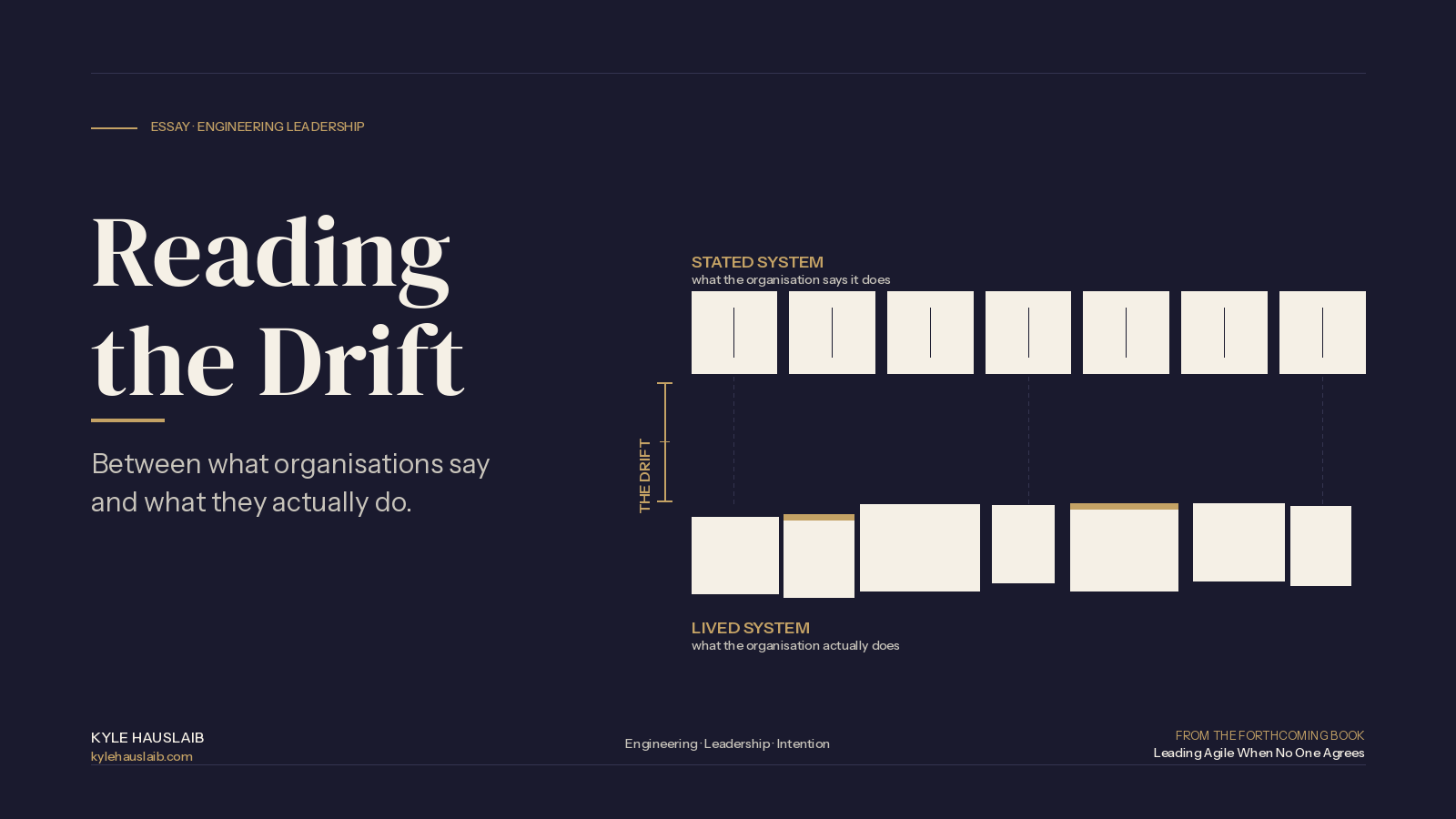
Every organisation runs two systems at the same time. The one it documents, and the one it actually operates. The distance between them is the Drift, and reading it is a leadership practice, not a clean-up project.
Two systems, one organisation
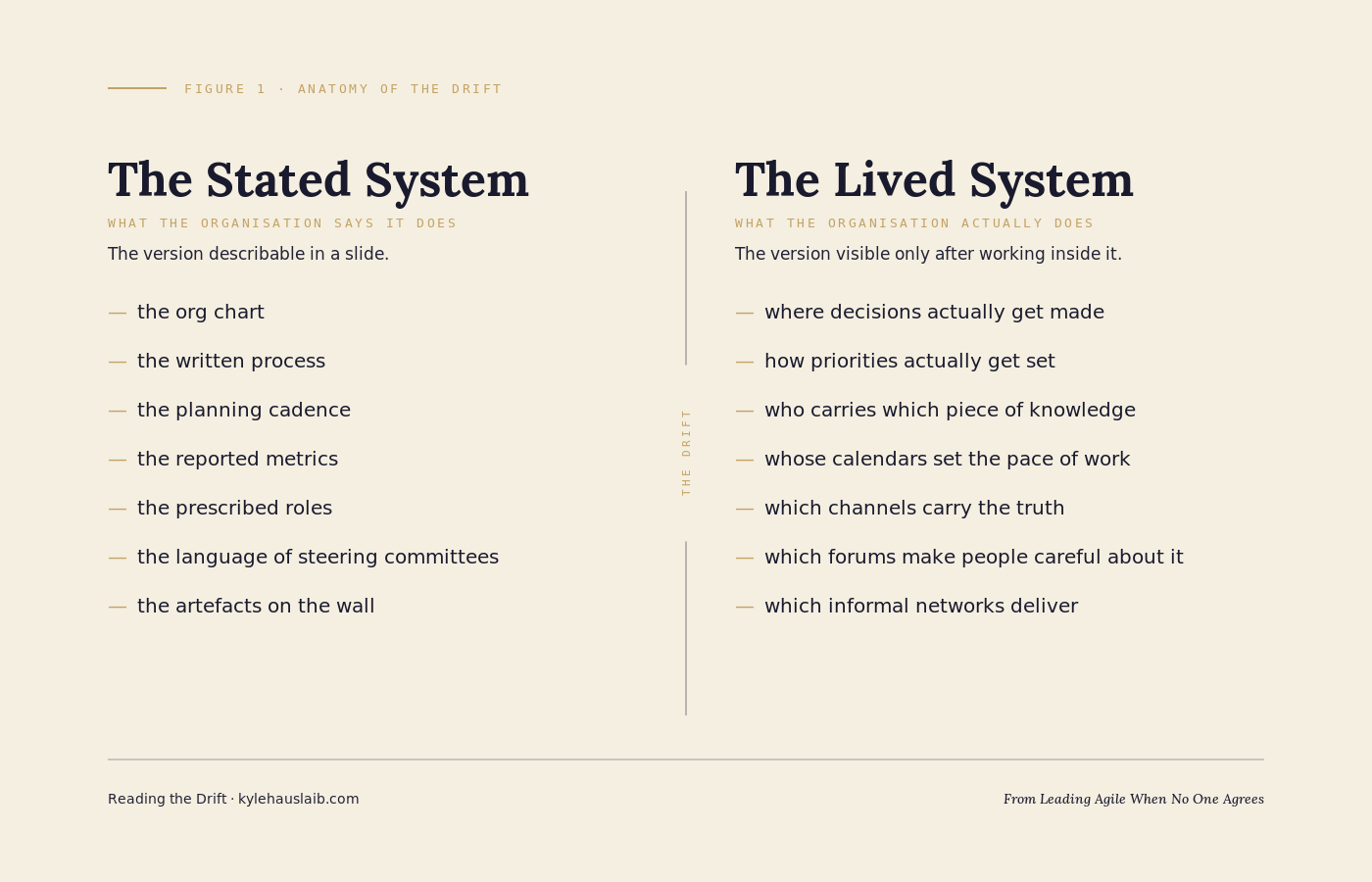
The Stated System is the version of the organisation that fits on a slide. The org chart, the planning cadence, the written process, the metrics that get reported, the roles that have job descriptions, the language used in steering committees.
The Lived System is harder to describe, because it lives in nobody’s documentation. It is where the real decisions get made, how priorities actually get set, who carries what knowledge in their head, whose calendars decide how fast certain work can move, which channels carry the truth, and which forums make people careful about saying it.
The distance between the two is the Drift. Some Drift is normal, and frankly it is even healthy. The problem is not that it exists. The problem is that it can keep widening in a direction nobody chose, while the status on the deck stays green.
What does work is to read the Drift instead of trying to close it.
The three Drift questions
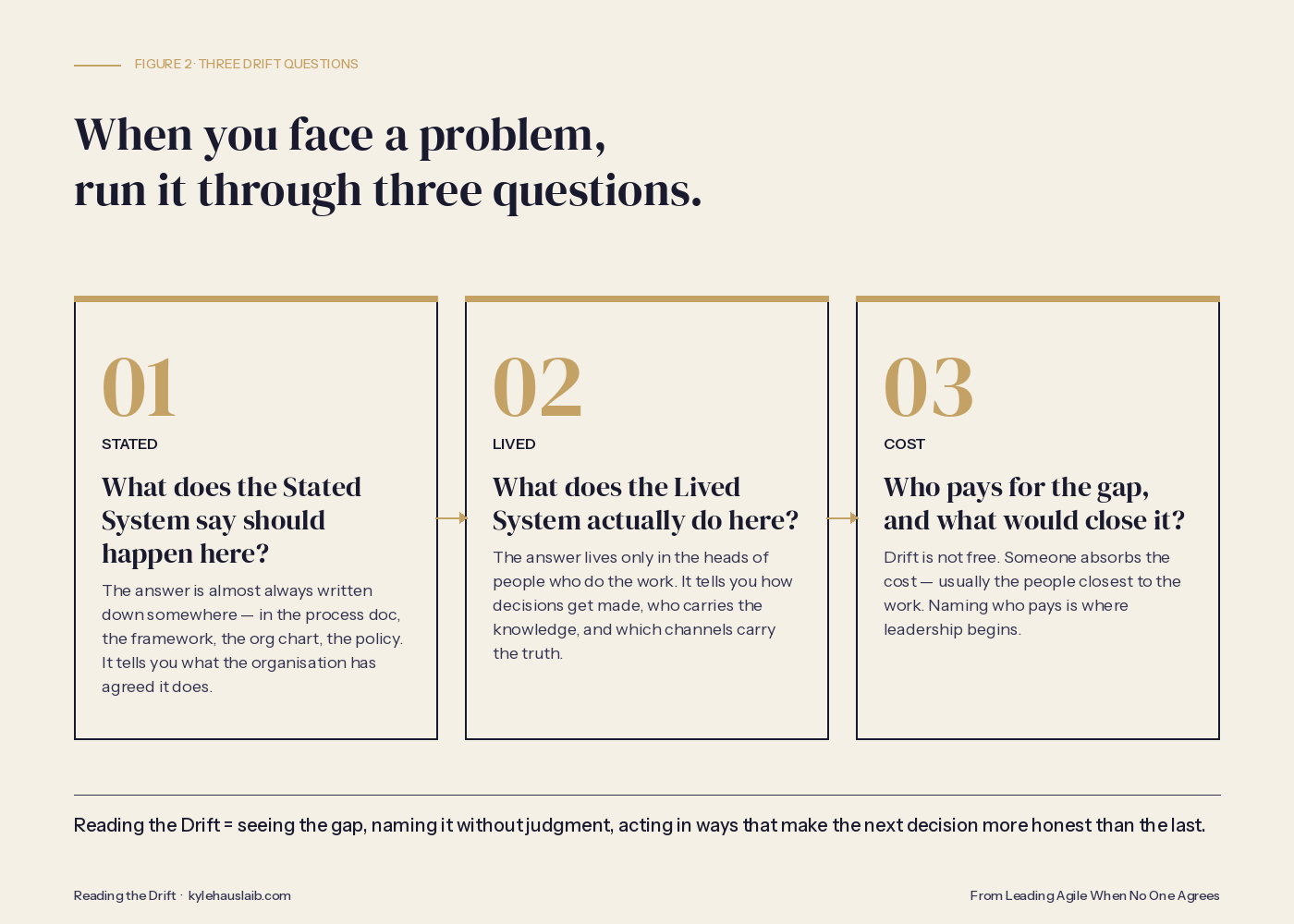
When I face a leadership problem that has gone stuck, I run it through these three questions in order. The first two surface the gap. The third one names who is paying for it, which is where the decision actually lives.
-
What does the Stated System say should happen here?
This question almost always has an answer in writing somewhere. The framework says one thing, the policy says another, the org chart implies a third. Whichever it is, I write it down in the words the system itself uses, since my own paraphrase would already be adding interpretation.
-
What does the Lived System actually do here?
This one only has answers in the heads of the people who do the work. The way to surface them is to ask in private, of the people who carry the load. Not in a workshop, not in a town hall. I do not ask how the process handles X. I ask what happens when X comes up. The answers come back in specifics: names, channels, calendars.
-
Who pays for the gap, and what would close it?
Drift is not free. Someone always absorbs the cost. Usually it is the people closest to the work, because they are the ones who carry the difference between what was promised and what is possible, by working harder, by working later, by working around. Naming who pays turns the Drift from an abstract feature into a concrete decision.
Leaders running scaled work that cannot be followed as written
The Drift is most useful to anyone whose job sits between a written framework and the people who have to make it survive contact with reality. The framework does not always need to be defended. Sometimes it needs to be described accurately first.
Engineers running ARTs or Solution Trains who feel the daily distance between the planning artefacts and what the trains are really doing.
Heads of engineering and senior managers who have to make decisions on incomplete pictures, and who are starting to suspect the slide deck is one of the things hiding the picture.
Agile coaches and transformation leads who have already tried tightening the process and noticed that it produces more ceremony, not more clarity.
Senior Scrum Masters, principal engineers and product leaders who have seen enough cycles to know when a green status is describing a project that no longer exists.
Fifteen years inside agile transformations
I did not arrive at the Drift as a theory. I arrived at it from inside the work, by seeing the same mismatch between process and practice repeat across different organisations and different industries. The framework is the part that became transferable. The book is the long treatment. The essay is the short one. This page is the front door.
Six ways to take the framework further
Reading the Drift
The long-form essay that introduces the framework, including the worked example of who absorbs the cost when the process is insufficient.
Read essay → EssayHow to Read a Delivery Board
A board that showed nine of nine features green while the programme slid, and the four readings that show where the work actually went: side-door intake, interface gaps, drift, and where the people are.
Read essay → DemoThe E/E Solution Tracker
A live, interactive delivery board for a scaled automotive programme, with the Drift readings built in as switchable lenses and a timeline that replays how the drift accumulates across one Program Increment.
Open the demo → BookLeading Agile When No One Agrees
Twenty-two chapters working the Drift through scenes from inside scaled engineering programmes. Sample chapter available now, full release Summer 2026.
Inside the book → CompanionWorksheets and the Drift Check
Seven printable diagnostics including the five-question Drift Check, plus drift-cli, a local-only command-line version that keeps every score on your own machine.
Get the worksheets → Work with meSpeaking, advisory, and coaching
Talks built on the Drift for leadership audiences, advisory engagements with engineering organisations mid-transformation, and one-to-one coaching for senior practitioners.
See formats →