The Standing Meeting Nobody Priced
A recurring meeting is one of the bigger purchases a team makes. It just never shows up on a budget.
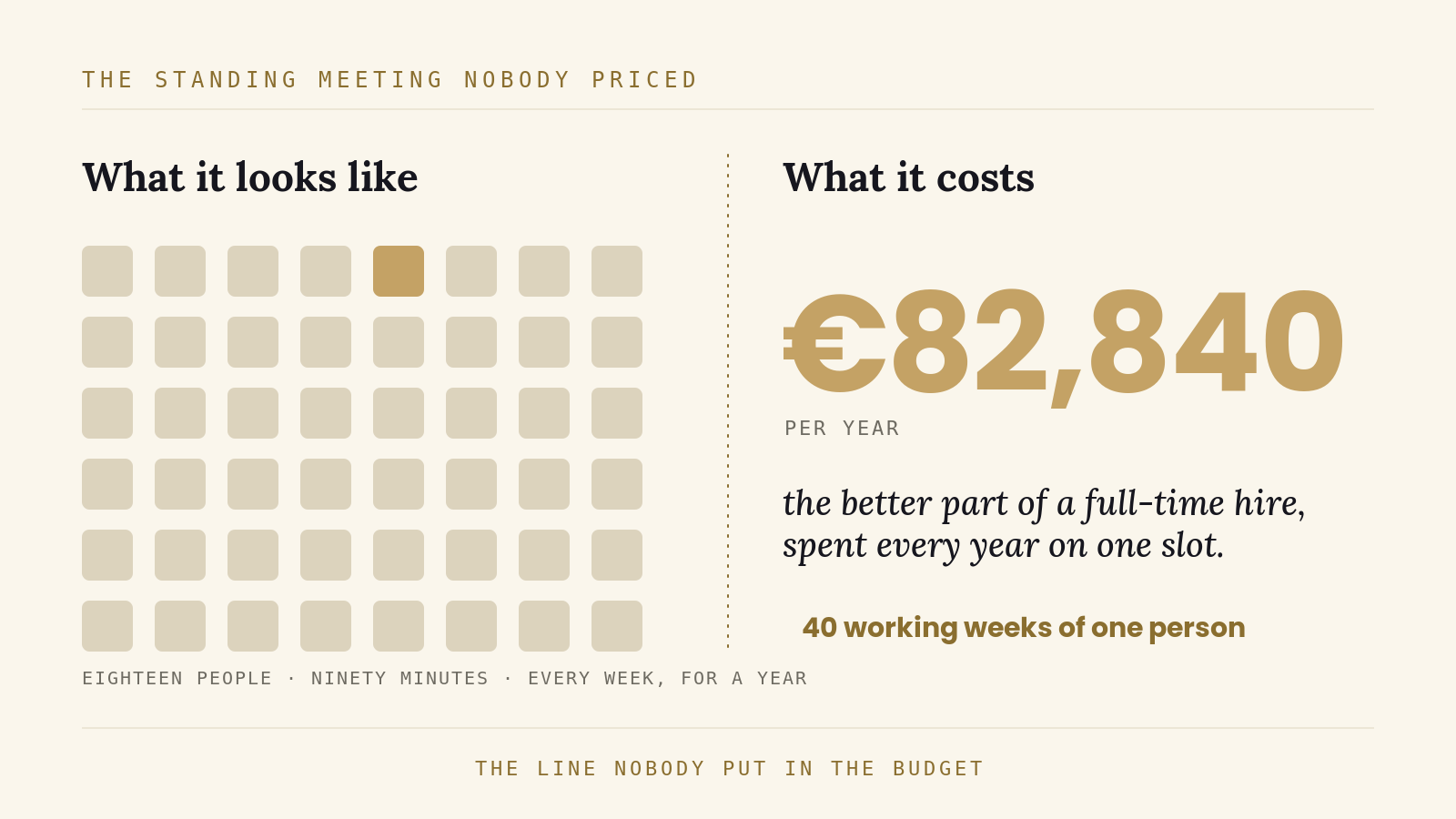
There was a meeting on my calendar every Monday morning for the better part of two years, and I never once asked what it cost. Eighteen people, ninety minutes, the same slot at the top of the week, held whether or not there was anything that genuinely needed that many of us in attendance. I kept defending it when budgets were tight, and again when people asked, carefully, whether they really had to be there, because it felt like the responsible thing to do, the kind of meeting a serious programme is supposed to have.
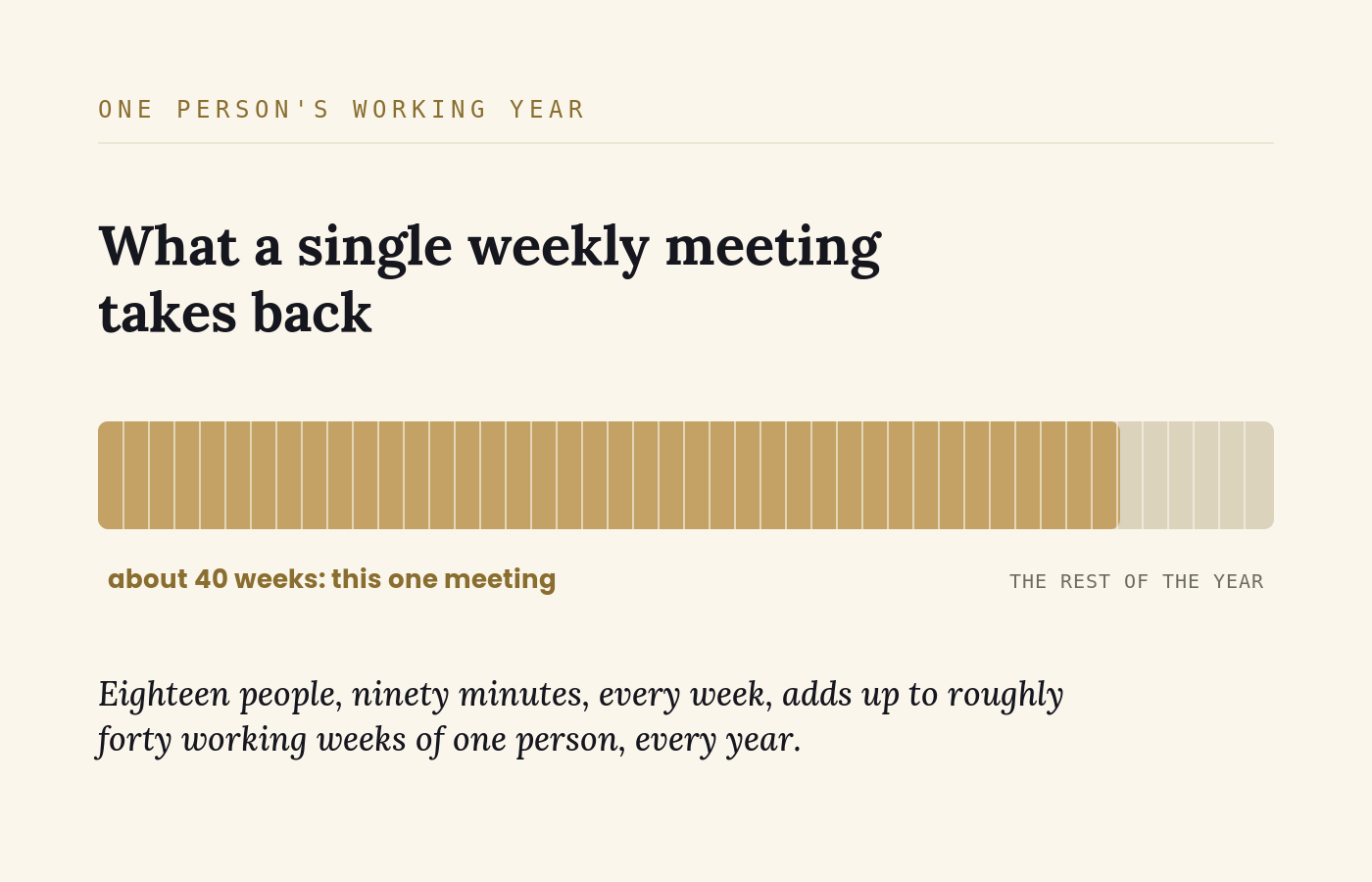
The first time I put its numbers into a calculator, the figure that came back was a little over eighty thousand euros a year, which is roughly forty working weeks of one person's time, or the better part of a full-time hire spent every year keeping a standing appointment alive on a Monday.
I should say the obvious thing first, because it matters: the meeting wasn't worthless, and some of those Mondays earned their place several times over. But I'd been making an eighty-thousand-euro decision every year without ever seeing the number, which meant I'd never really made the decision at all. The meeting simply renewed itself, the way standing meetings do, long after anyone could remember the conversation that first put it on the calendar.
Want your own number first? If you'd rather see what your own standing meetings cost before you read another word, that's the right instinct. The Meeting Cost Calculator will price any recurring meeting in about a minute, in your browser, with nothing sent to a server.
The one cost nobody puts in a budget
We're good at pricing almost everything else. We know what a licence costs and what a contractor charges by the day, and we can price a laptop, a desk and a seat licence without much thought, and we'll happily argue for a week about whether some tool worth a few hundred euros a month is justified. The thing we treat as if it were free is the thing we spend most of, which is the working time of the people we've already hired. Because those hours are paid for whether we use them well or badly, and because the money has already left the building, the meeting that consumes them looks free at the point of use. It isn't, of course; it's prepaid, and prepaid things turn out to be the easiest in the world to waste.
A recurring meeting is a purchase, and one of the larger ones a team makes, but it arrives disguised as a calendar entry, and a calendar entry carries no price. It never passes through procurement, and nobody is ever asked to sign off the annual spend, because the spend stays invisible until you multiply it out. Eighteen people for ninety minutes doesn't feel like much until you remember that it happens every week for a year, with the half hour of resettling on either side that a midweek interruption really costs, and by then it has become something far larger than it ever looked.
Where the cost hides
I spend a good part of the book on what I call the Drift, the gap between the system an organisation says it runs and the one it actually lives inside, and a standing meeting is one of the cleanest places that gap opens up. On paper, my Monday meeting existed for decisions and alignment. In practice, most weeks, it had settled into a status round that could have been an email, attended by eighteen people because the invitation had once listed eighteen people and nobody had taken on the small, awkward job of trimming it. The stated purpose stayed on the calendar long after the lived purpose had shrunk into something far smaller.
That sort of drift is expensive precisely because nothing about it draws attention. A meeting that has stopped earning its keep gives off no signal that anything has changed, so it goes on occupying its slot and producing the comfortable impression that coordination is happening, while the cost accumulates in the background, in hours that were paid for long ago. It's coordination debt, and like most debt it's easy to take on and easy to keep servicing without ever registering the size of the balance.
A recurring meeting is a purchase that arrives disguised as a calendar entry, and a calendar entry carries no price.
A small tool for an invisible number
So I built a small thing to make the number visible. The calculator does something deliberately plain: you tell it how many people attend, for how long, how often it recurs, and what a person there costs once you load the salary fully, and it hands back the cost per session, per month and per year. You can start from a ceremony you'll recognise, whether that's a daily standup, sprint planning, a retro, PI planning or a scrum of scrums, and it fills in the usual shape for you, or you can describe a standing meeting of your own.
Because a single number is easy to wave away, the tool translates the annual figure into terms that are harder to dismiss, showing how many whole working weeks of one person it represents and how many full salaries it amounts to over a year. Eighty thousand euros is an abstraction in a way that forty weeks of somebody's working year, every year, simply isn't. There's also a switch for the preparation and context-switching that a recurring interruption genuinely costs, since a meeting takes more than the ninety minutes on the invitation; it takes the time on either side that nobody ever writes down.
The decision I cared about most was to show the working, so a panel opens the whole calculation line by line, from the hourly cost of a person through to the yearly total. A provocative number that hides its arithmetic is only another thing asking to be believed, whereas one that shows its arithmetic is an argument you can check, disagree with and then act on. You can change an assumption and watch the figure move, or switch the currency to match where you sit, and when you land on a version worth keeping you can download a one-page summary or copy a link that reopens the exact scenario you were looking at.
If you want the figure that made me build it, set it to PI planning for a single Agile Release Train: fifty people, two days, four times a year, at ninety thousand euros a head fully loaded. It comes back a little over two hundred thousand euros a year. That isn't an argument against PI planning, which is one of the few large meetings I'll defend at length; it's an argument for knowing the price of what you're defending, so the defence is a real one rather than a reflex.
What the number is for
Let me be clear about what this isn't. It isn't an accounting instrument, and it certainly isn't a case against meetings, since the best ones I've sat in were worth many times what they cost, and a team that responds to this calculator by cancelling everything has only found a fresh way to coordinate badly. The figure exists to start one particular conversation: does this meeting still earn the slot it defends, and if you can't say what it decides, what is it that you're actually buying?
Most meetings survive that question, and they should, because once you can name the decision a meeting produces and the people who genuinely need to be present to make it, you'll usually find a leaner version that protects the same outcome for a fraction of the cost. My Monday meeting didn't need cancelling; it needed to be eight people for half an hour, with the other ten reading a summary afterwards, and the only reason that took two years and a number to work out was that the cost had never been made large enough to notice.
I've watched the same thing happen in front of a few teams now. The annual figure lands on the screen, somebody converts it almost involuntarily into something concrete, and what they say is some version of, “That's a person. That's a whole person we could have hired.” Everyone goes still for a moment, and then the conversation that actually matters begins, which is the one about what the meeting is for. The figure was never the point; it's the thing that finally makes the point worth discussing.
Pick the meeting you defend most reflexively, the one you'd feel uneasy cancelling, and put its real shape into the Meeting Cost Calculator: the true headcount on the invitation, the real length including the time on either side, and a fully loaded cost per person. Then say out loud what the meeting decides and who genuinely needs to be present to decide it. Name both and you have a meeting worth its price; fail to, and you've found the most expensive line nobody ever put in the budget.
The scenes in this article are anonymised and, where necessary, composited from multiple professional contexts. They describe a pattern in how organisations spend their own time, not a specific employer, programme, or team.
The calculator is one of a handful of tools I've been building to make the Drift framework something you can handle rather than only read about, alongside a live delivery board and the five-question Drift Check from my book, Leading Agile When No One Agrees, which is out now in paperback. The diagnostics that travel with it are free: the Drift Check runs in your browser or, for anyone who would rather work in a terminal, as drift-cli that never sends the result anywhere, and the worksheets sit on the companion page. The meeting calculator is the bluntest of the three, which is rather the point, because money is about as blunt as instruments get, and sometimes the fastest way into an honest conversation about how an organisation really works is to put a price on the one hour everyone had agreed to treat as free.
Run the numbers on your own standing meetings with the Meeting Cost Calculator. It runs in your browser, and nothing you enter is sent to a server.
More writing and book launch updates at kylehauslaib.com.