PI Planning Is a Negotiation
Sixteen of nineteen committed features were settled before the event began. What the two days are for, what the confidence vote measures, and how to run the trading where every team can see it.
 View on Medium ↗
 View on Substack ↗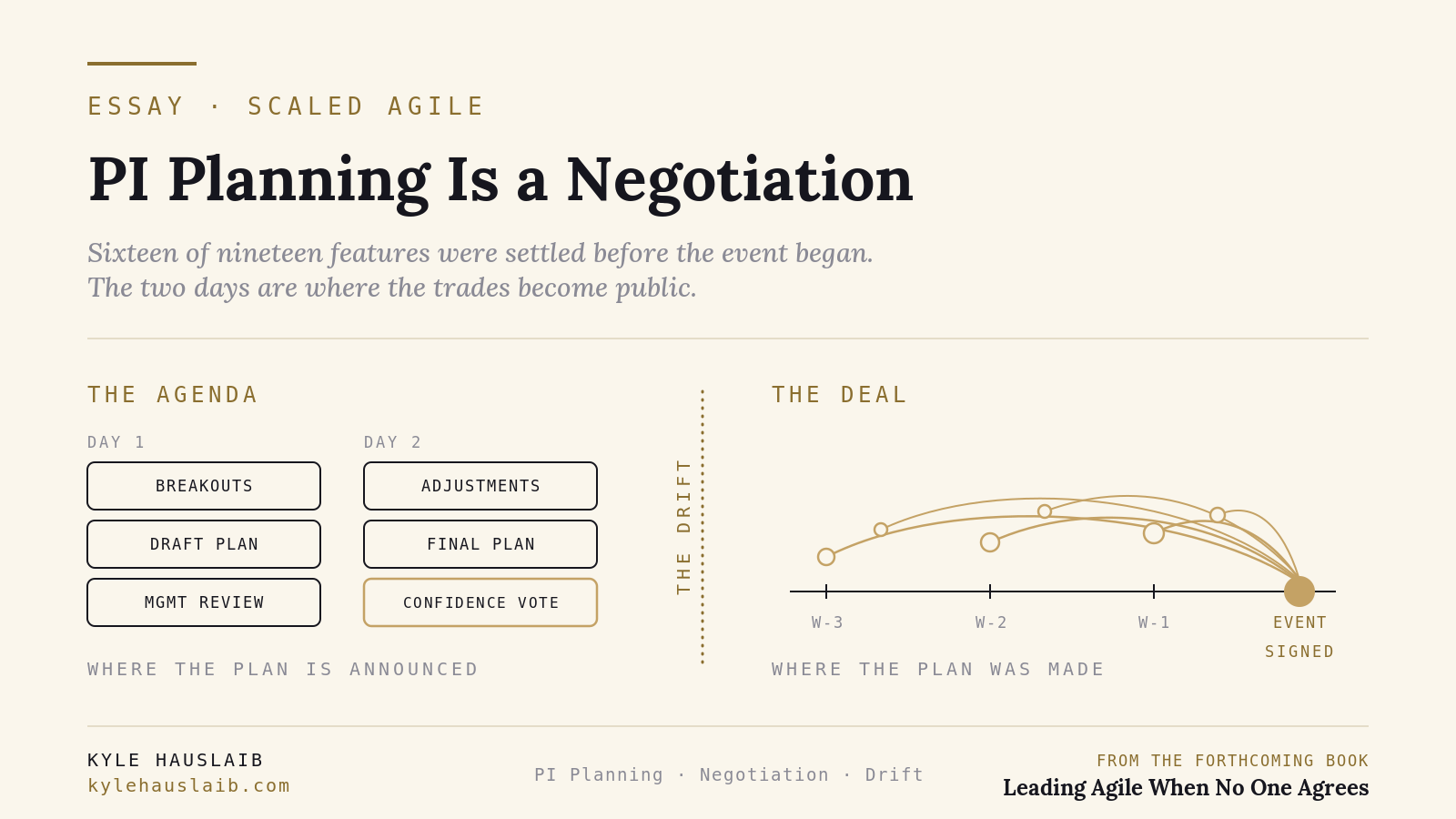
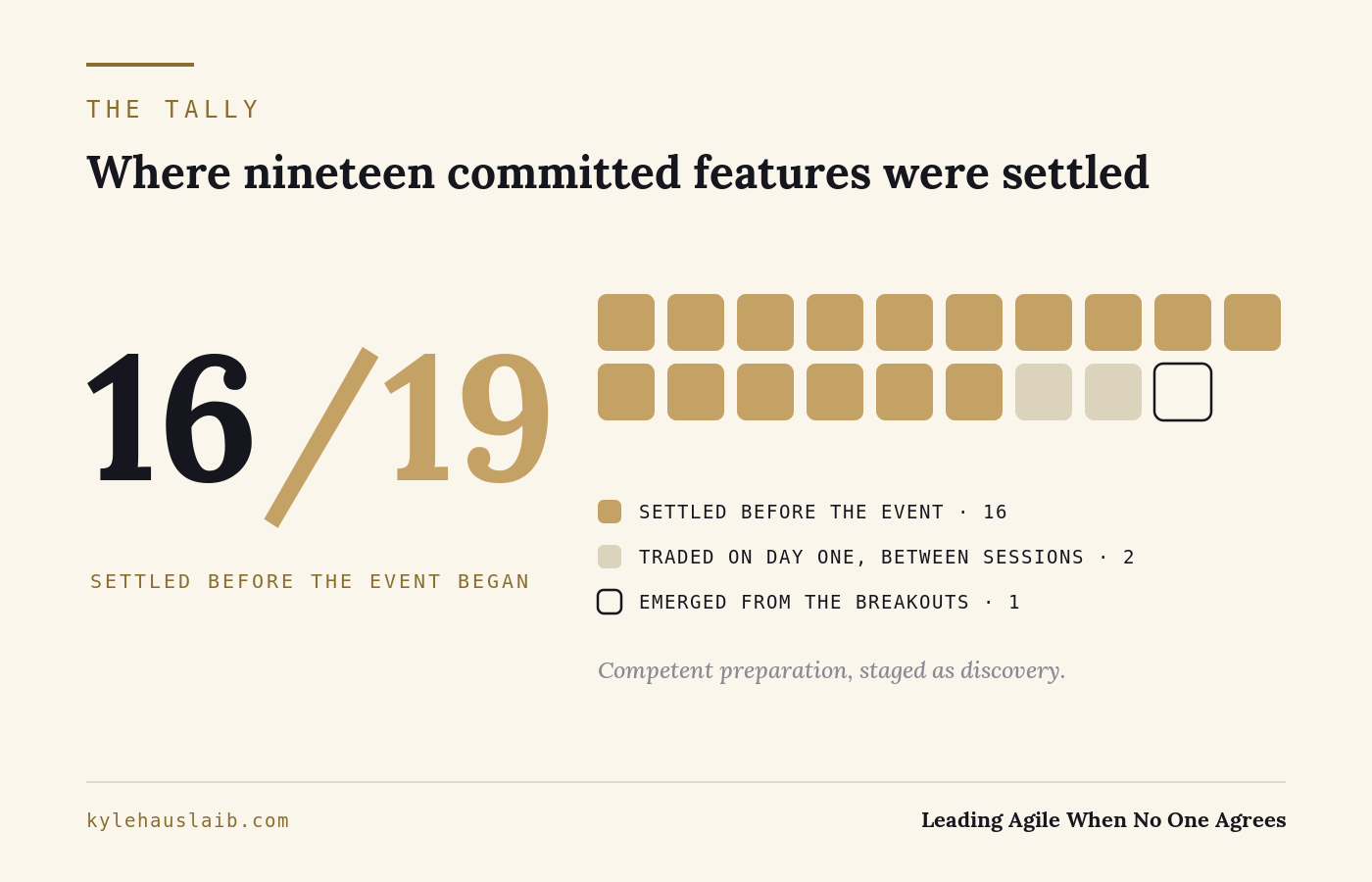
There is a tally I kept during one PI Planning that changed how I run them. Every feature that reached the final plan review with a committed label, I traced backwards through my notes and my inbox to the moment it was settled. Nineteen features were committed that afternoon. Sixteen of them had been agreed, scoped and capacity-checked before anyone travelled to the event. Two were traded over coffee on the first morning, between sessions, by people who knew exactly what they were doing. One came out of the team breakouts the agenda is built around.
I want to be fair to the official version, because it is more sensible than its critics allow. The framework asks for preparation: refined features, a vision briefing, estimates that have seen daylight. What it stages inside the two days is the planning itself. Teams lay features into iterations, discover the dependencies between them, surface risks, and commit to objectives in front of the whole train. The agenda promises that the plan will be assembled there, by the people who will deliver it, with everyone watching. That is the Stated System, and I ran it for years on trains large enough that the event needed a hall.
The Lived System ran on a different calendar. The plan was made in the three weeks before the event, in capacity arguments between product management and the teams, in a feature withdrawn in exchange for a hardening iteration, in an architect lobbying two product owners over lunch, in the message that begins: before Thursday, can we align on. By the time the train assembled, the load-bearing decisions had owners, dates and an understanding attached. The breakouts mostly transcribed them.
For a long time I read my tally as an indictment. The event was meant to be where planning happened, we kept arriving with the planning done, so we were doing it wrong, and the fix was to come in colder. The year we tried that remains one of my least favourite memories of the job. A train of a few hundred people cannot discover its trade-offs from a standing start in two days. The management review on the first evening ran past 5pm, and the plan the train voted on the next morning had been assembled at a whiteboard by six exhausted people long after everyone else had left. We had pushed the negotiation out of the weeks where it had time to breathe and into a single evening where it had none.
What the two days are for
The reframe came from a different field. Heads of state do their signing at summits, and almost nothing at a summit is decided there. The agreements are settled in advance by officials who spend months trading clauses. Nobody calls the summit a failure for it. The summit exists to make the agreement public, to bind the principals to it in front of witnesses, and to raise the cost of walking away. The signing turns months of trading into something a government can be held to.
A trade agreed in a corridor in week minus three binds nobody. The same trade, said aloud at the draft plan review with the receiving team in the seats and the date on the wall, is expensive to break.
PI Planning earns its two days the same way. The event converts private trades into public, reciprocal obligations, and it gives every team a view of the trades that affect them, including the ones made in their absence. When I stopped grading the event on how much planning happened inside it and started grading it on how much of the negotiation became visible inside it, the same two days went from theatre to the most useful fixture on the calendar.
The framing also changes who you prepare. A product owner walking into the weeks before the event without a position, a list of what their team can absorb, and a clear idea of what they need from others, is a negotiator arriving at a summit without instructions. Their team will still get a plan. It will be written by the counterparties.
What the confidence vote measures
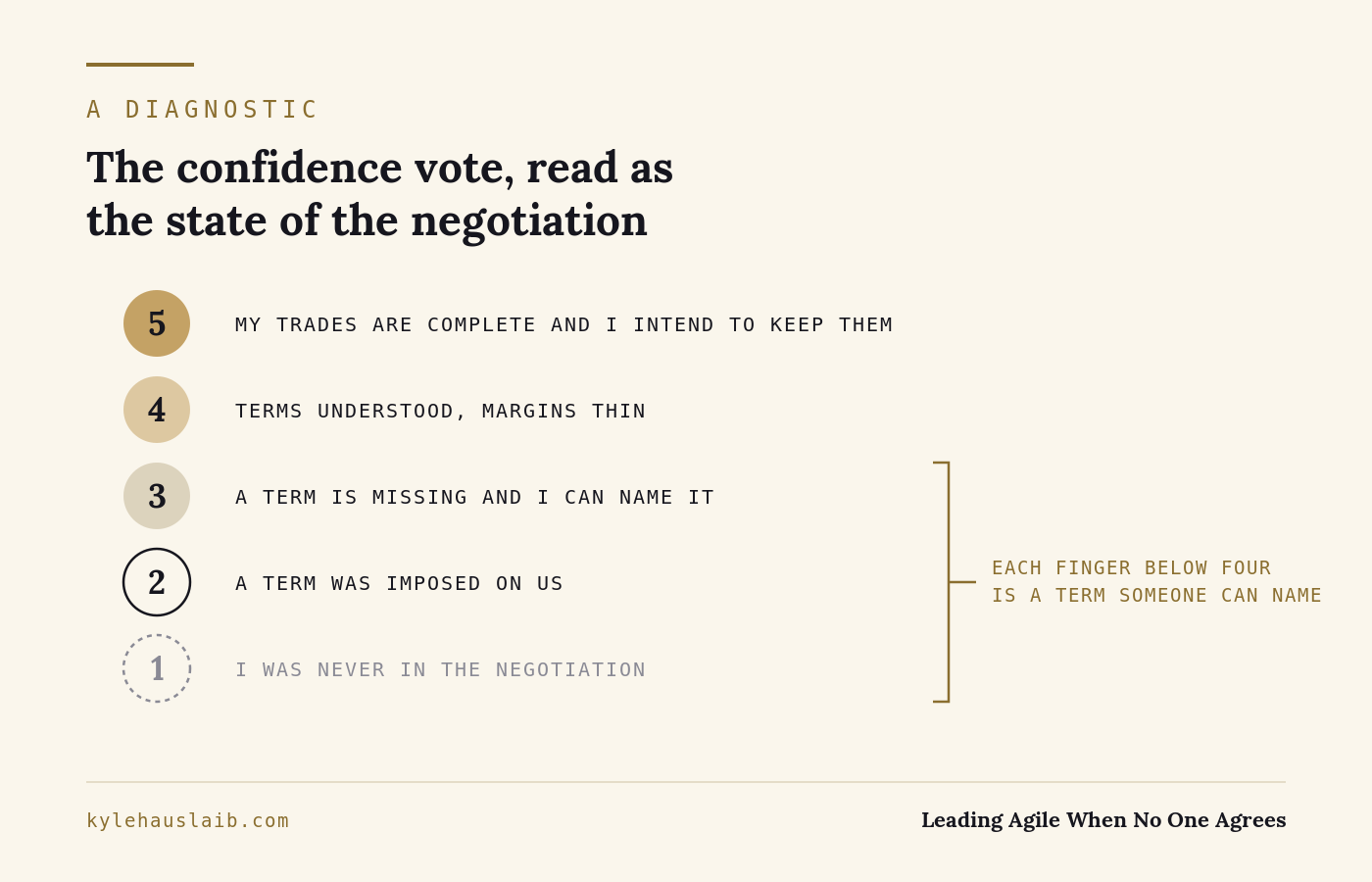
The vote at the end is the part most often performed and least often used. The choreography is familiar: objectives on the wall, the facilitator asks for fingers, a forest of fives and fours, scattered threes, and somewhere a two that everyone hopes won’t slow things down. Officially it measures confidence in the plan. Read it instead as the state of the negotiation. A five says: my trades are complete and I intend to keep them. A four says: terms understood, margins thin. A three says: a term is missing and I can name it. A two says: a term was imposed on us. A one says: I was never in the negotiation at all.
I learned this from an engineer who voted two at a final plan review while the rest of her team held up fours. The facilitator did what good facilitators do, which is ask, and she answered with a precision I have been grateful for since. She said: the dependency on the platform team was accepted at the management review last night, and nobody asked the platform team. She was right. The acceptance had been agreed between two managers after the teams had gone to dinner, and the people expected to deliver it heard about it from the wall. We reopened it, the platform team counter-offered a date one iteration later, and the plan that came out was poorer on paper and the only version with a chance of being true.
Run that way, the vote is an audit with a sample size of every person on the train. Each finger below four is a term someone can name, and each named term either gets repaired on the spot or written down as a risk with an owner. Talked upward instead, the vote measures the stamina of the facilitator.
Where the pretence gets expensive
None of this argues for less preparation. The drift I care about sits somewhere narrower: in the distance between an organisation that says its plan emerges in the event and one that makes the plan beforehand and stages its discovery. That pretence has a price list.
Trades made in corridors carry no record, so by week four the two sides remember different terms. You said iteration two. I said we would attempt iteration two. Teams whose leaders trade well in the weeks before arrive with humane loads, while teams whose leaders sit out the pre-game get loaded in their absence, and the event then launders that into a commitment they appear to have made themselves. And the management review, the one block on the agenda that admits to being a negotiation, happens at the end of the first day, after most of the people who must live with its outcomes have left, which is how a plan can change more in ninety minutes than in the eight hours of breakouts before it.
Every one of these stays invisible while you hold the official theory, because the official theory says the trades do not exist.
Negotiating in daylight
What helped was small and administrative. Most useful things are. Before the event, we began publishing the settled list: one page, every feature already agreed, where it was settled and by whom. The first version embarrassed several people, me included, since it put sixteen of nineteen in writing. It also freed the breakouts. Teams stopped performing the discovery of conclusions reached the week before and spent the time on the three features that needed it.
During the event, the dependency board became a ledger. Every accepted dependency got a named owner at both ends, a date said aloud, and a return commitment, because an IOU with one signature is a wish. The board stopped being decoration photographed for the readout and became the most contested surface in the building.
And at the vote, we collected terms instead of massaging the number. Every two and three was asked for its missing term, out loud, with the same respect a five got. Some terms were repaired before the train went home. The rest went onto the risk list with an owner and a date, which is where they would have surfaced anyway, eight weeks later, wearing a different name.
Back to the tally
I still count. The number has stopped bothering me, because sixteen of nineteen settled early is what competent preparation looks like in any organisation older than its slide deck. The question I bring to the count has changed. For each early settlement I ask whether it was made where the affected teams could see it, and whether both ends of every trade inside it carry names. Negotiation is how every plan worth committing to gets made. The drift sits between an agenda that stages emergence and a calendar that runs on trades, because the distance between those two is where imposed terms hide. An imposed term collects its payment around week six, with interest.
After your next PI Planning, or your next quarterly planning event, trace every committed item back to the moment it was settled and mark it: before the event, on the floor between sessions, or at the management review. Keep the count to yourself at first; it tells you where your plan is made. Then pick one accepted dependency and check that it has a named owner at both ends and a return commitment. Whatever is blank is the negotiation you still owe, and it costs less now than in week six.
The scenes in this article are anonymised and, where necessary, composited from multiple professional contexts. They are intended to describe a pattern in large-scale planning events, not a specific employer, programme, or team.
The distance between the system an organisation describes and the one it runs is the spine of the Drift framework, which carries my book Leading Agile When No One Agrees across twenty-two chapters of scenes drawn from fifteen years inside agile transformations. The book is out now. If this piece resonates, the companion worksheets may be useful in the meantime, starting with the five-question Drift Check. For anyone who would rather work in a terminal, drift-cli runs the same check locally and never sends the result anywhere.
Curious how far your own organisation has drifted? The two-minute Drift Check gives you a reading in your browser. Nothing is stored or sent.
More writing and book launch updates at kylehauslaib.com.