The Org Chart Won’t Tell You Who Will Move
Leading the people who don’t report to you, the one lever you have left when authority runs out, and why the structures we build to coordinate teams can quietly drain the very motivation we keep asking them for.
 View on Medium ↗
 View on Substack ↗
 View on LinkedIn ↗
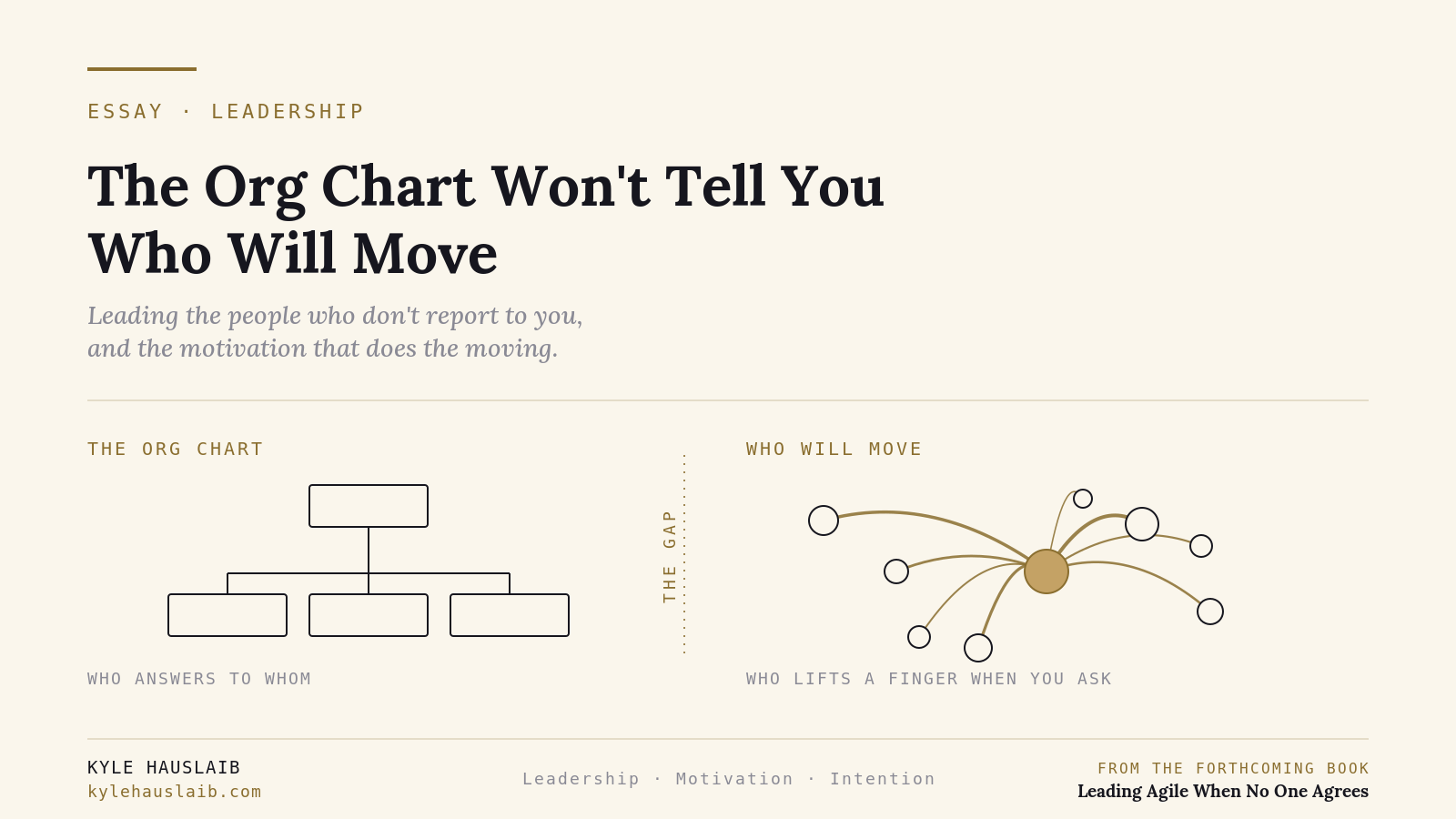
I once counted eleven people in a meeting, and not one of them worked for me. We had gathered to rescue a delivery that already slipped twice, and on paper I owned the outcome. In practice I owned nothing any of them was obliged to do. The engineers reported elsewhere, the designer sat in another function, and two of the managers present outranked me comfortably. One of them spent the first ten minutes on his phone, and I decided not to say anything, because I had no standing to.
Someone had given me accountability without the authority people assume comes attached to it. That gap described my job for years, and for a long time I treated it as a fault in the arrangement rather than the real shape of the work.
Early on I believed authority was the engine and everything else was decoration. Give a manager the reporting line, the budget and the title, and the rest would follow. What I learned instead, slowly and with some embarrassment, was that the managers who leaned hardest on their authority moved people the least. The org chart told me who answered to whom. It said nothing about who would lift a finger when I asked.
What command could never do
The managers I came to admire rarely reached for their formal power, even when they had plenty of it. They moved people by making the work make sense to the person being asked. Authority only ever bought them a shortcut past the question of why someone should care, and that shortcut worked until the task got hard or dull or frightening. After that it bought compliance and little else, and compliance never rescued a slipping delivery.
So the disadvantage I felt in that meeting, the missing lever marked obey, was just the normal condition with the comfortable illusion removed. Every leader borrows other people’s willingness, and some of us simply get to pretend otherwise for longer. Leading people who did not report to me forced me to face that early, because I had nothing else to reach for.
The thing I was reaching for had a familiar name once I stopped flinching from it. Researchers spent decades describing intrinsic motivation, the pull that comes from autonomy, from mastery, and from a purpose a person already carries before you turn up with a request. For years I filed that under wellbeing, the sort of thing a thoughtful manager dealt with once the real work was divided up. The meeting of eleven corrected me. Across a boundary I couldn’t command, that pull was the only thing that got anything done.
One lever, two ends
I had treated intrinsic motivation and leading without authority as two separate skills, one about looking after people and the other about politics. They turned out to be the same thing seen from opposite ends.
Authority lets you skip the question of why someone should care. Leading without it is the job of never being allowed to skip that question.
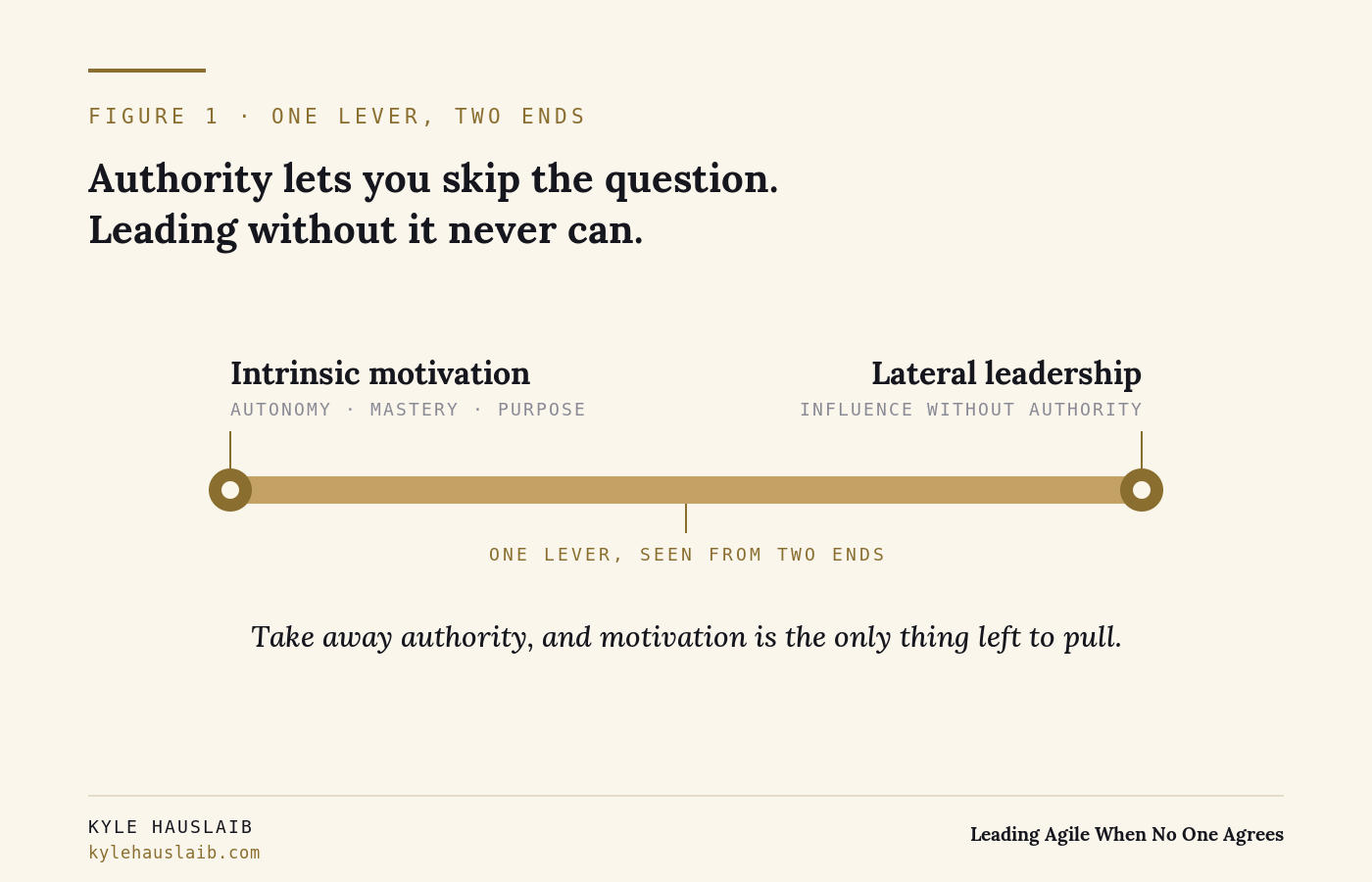
When I had no power over someone, the only thing that moved them ran through something they already wanted, and the difference showed up in how I asked. Early on I would say: could you take this on. That aimed at compliance and earned a shrug. Later I learned to tie the ask to what the person was trying to get good at, or to something they cared about for reasons that had nothing to do with me, and that version moved people.
None of this made me a softer manager. It made me a more honest one, because I lost the ability to mistake someone’s silence for agreement. Once the only thing I could spend was a colleague’s genuine willingness, I had to go and find out what they genuinely wanted.
The part most of us would rather not admit
The story would be tidy if it ended there, with a lesson about purpose. The harder bit sat one layer down, and it implicated the structures I helped build.
I watched motivated teams go quiet more than once, and every time the cause was something we built on purpose. We added a cadence to bring order to chaos. We put in dashboards to make progress visible. We stood up alignment meetings so the right people stayed informed. Each move was defensible on its own, and together they taught capable teams to stop deciding and wait for instruction. The structure swallowed the autonomy we kept praising in town halls.
That is the drift I write about now. An organisation keeps a Stated System, the version it documents, full of empowered teams and ownership and trust. It also runs a Lived System, the version people meet on a Tuesday afternoon, where volunteering a decision invites a review they would rather avoid. The distance between the two is where motivation gets engaged or quietly leaks away. Someone leading without a reporting line ends up living in that distance, because it is the only ground they have.
Working the gap
What helped me was not a model. It was a few habits aimed at the gap itself.
I protected autonomy inside the structure instead of pretending the structure away. A cadence does not have to remove choice, as long as you use it to hand decisions back rather than collect status. When I ran a recurring meeting as a service to the people in it, a place where blockers got cleared and judgement got returned, the same ritual that once felt like surveillance started to feel like support.
I also leaned on purpose to carry more than process could. People put up with a surprising amount of coordination when they can see what it serves, and they resent even a little of it when they can’t. So I spent more effort than felt natural connecting the cadence to something the team valued, and less on perfecting the mechanics I used to fuss over.
And I tried to give decisions back. Whenever a structure I owned had swallowed a choice that belonged to the people doing the work, I treated that as a fault to fix. People grow when they make real calls and live with the results, and they shrink when they get managed into waiting, however kindly it is done.
Back to the eleven
That rescue came good, though not because I found some hidden source of authority. I didn’t. I spoke to people before the meeting, one at a time, and tried to work out what they needed from the situation besides please save this delivery. Two wanted visibility for work that had been ignored for months. One wanted a technical decision unblocked that had been sitting with a director for three weeks. One simply wanted someone to stop moving the target every Friday. For two people I had no idea, and that blank was the useful part, because it showed me where my influence was imaginary.
The thing that turned it was small and a bit unglamorous. I got the director to make the call that had been stuck, said so in front of everyone, and credited the engineer who first flagged it. The meeting changed temperature after that, because people could see the asking went somewhere.
The org chart still hung on the wall when it was over, as accurate and as useless as ever. It described who answered to whom with total confidence, and it stayed quiet on the only question that mattered that month, which was who would move when I asked, and why.
Pick one person you rely on who doesn’t report to you, and write down what they are trying to get good at, or what they care about beyond the task in front of them. If the page stays blank, that blank is the finding. On your next ask of that person, tie the request out loud to whatever you wrote. Then take one meeting or report you own and ask whether it hands a decision back to the team or quietly takes one away, and repair the ones that take.
The scenes in this article are anonymised and, where necessary, composited from multiple professional contexts. They are intended to describe a pattern of leadership and motivation, not a specific employer, programme, or team.
The distance between the system an organisation describes and the one it runs is the spine of the Drift framework, which carries my book Leading Agile When No One Agrees across twenty-two chapters of scenes drawn from fifteen years inside agile transformations. The book is out now. If this piece resonates, the companion worksheets may be useful in the meantime, starting with the five-question Drift Check. For anyone who would rather work in a terminal, drift-cli runs the same check locally and never sends the result anywhere.
Curious how far your own organisation has drifted? The two-minute Drift Check gives you a reading in your browser. Nothing is stored or sent.
More writing and book launch updates at kylehauslaib.com.